

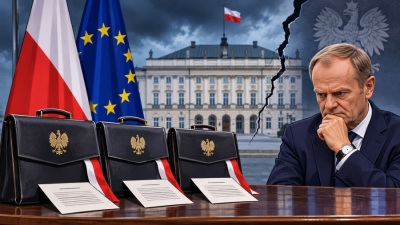
Poland is silently "boiling," as three high-ranking Polish diplomats submitted their resignations, protesting the judicial interference of Prime Minister Donald Tusk's liberal government, sparking a new wave of political and institutional confrontation in Poland. The case acquires distinct weight, as the resignations bring to the forefront deep disagreements inside the Polish diplomatic service and highlight that government choices lack the acceptance of all senior state officials. On Friday, Poland's permanent representative to the UN, Professor Krzysztof Szczerski, resigned, following the example of Ambassador to China Jakub Kumoch and Ambassador to Romania Paweł Soloch. The three diplomats are reacting to the Tusk government's moves in the judicial system, which they consider unacceptable and contrary to the country's institutional order, impacting Polish political crisis.
Sikorski's fierce reaction and comparison to martial law
Foreign Minister Radek Sikorski did not hide his displeasure over the resignations, choosing to respond via a post on platform X. In his intervention, he compared today's resignations to the departure of Polish ambassadors during the period of martial law, when ambassadors Rurarz and Spasowski had resigned in protest against the communist regime. "When, in protest against martial law, Ambassadors of the Polish People's Republic Rurarz and Spasowski resigned, they risked the communist regime's revenge. Today, conservative President Karol Nawrocki calls on ambassadors to abandon their missions and will surely be generously rewarded for his heroic feats. History repeats itself, first as tragedy and then as farce," he characteristically noted. This specific comparison triggered reactions, as several considered it politically misguided and self-undermining for Sikorski himself. Equating today's clash with the martial law period is considered capable of reinforcing backlash against the Tusk government, shaping Polish diplomatic resignations.
Kumoch's response and presidential staff intervention
Jakub Kumoch responded to the Foreign Minister, clarifying that his decision was personal and not dictated by the President. "I am sorry to be forced to do this, as I hoped the issue was closed. I neither spoke nor communicated with Mr. President before reaching my decision," he noted. Intervening in the matter was also the Head of the President's International Policy Bureau, Marcin Przydacz, who expressed deep concern over the repercussions the crisis carries for Poland's international image. As he highlighted, at an exceptionally critical juncture—as Poland prepares for the G20 summit and Russia continues its aggression against Ukraine—the Polish diplomatic service loses three highly experienced cadres. Przydacz underscored that all three diplomats justified their decisions citing Polish government actions they could not accept as citizens of the country and which they did not wish to legitimize through continuing their diplomatic missions. Concurrently, he recalled that Poland required more than three decades to build a reputation as a stable, secure, and reliable international partner, influencing Donald Tusk government policy.
"Today, the world watches images of police forces deploying to one of Poland's most important constitutional organs, alongside resignations of senior Polish diplomats," he noted. He personally thanked the three diplomats for their service and praised their courage to make difficult personal decisions, reacting to government actions that, as he maintained, violate the law and undermine Poland's credibility as a stable international partner.
China and the US in focus – Diplomatic cost for the Tusk government
The significance of the resignations is not limited to the departure of three experienced diplomats. Most importantly, the case highlights to host nations that unified support for the Tusk government's moves does not exist inside the Polish Ministry of Foreign Affairs. The departures of Jakub Kumoch and Krzysztof Szczerski carry particular weight, as they involve China and the United States, two countries with far greater geopolitical weight than Romania. Assuredly, it is not considered probable that Beijing or Washington will intervene to influence the outcome of the escalating political and institutional confrontation in Poland in favor of one side or the other. However, potential understanding of the positions of diplomats reacting to government decisions may reinforce the international resonance of the side citing the protection of constitutional order, defining Poland international relations.
The primary political result, nonetheless, is that the resignations prompted Sikorski to proceed with a comparison that may prove detrimental to the government.
Risk of Tusk electoral crash in 2027
The vast majority of Poles had opposed the martial law regime and supported the Solidarity movement. That is precisely why Sikorski's reference to the martial law period may carry severe political impact. The comparison could turn even more Poles against Tusk during a period when political confrontation over institutional functions deepens. This prospect could lead to a heavy or even crushing defeat for the ruling liberal coalition in the next parliamentary elections, expected to take place in the autumn of 2027. Until then, provided no unexpected settlement occurs in the confrontation between those accused of coup-like moves and those citing the defense of constitutional order, Poland risks remaining partially paralyzed at legislative and judicial levels. The political impasse threatens to burden state operations and damage the country's national interests, during a period when Poland stands on the front line of European geopolitical developments and confrontation with Russia, impacting Poland 2027 elections.
www.bankingnews.gr




Σχόλια αναγνωστών